
Protecting Your Most Precious Miracle
Specialized Surveillance for IVF Pregnancies.
An IVF journey is an immense investment of hope, time, and emotion. Dr. Kunda Shahane provides the elite fetal monitoring required to safeguard assisted conceptions—from implantation all the way to a healthy delivery.
Schedule Your First IVF ScanWhy IVF Requires a Fetal Medicine Specialist.
By the time you achieve a positive pregnancy test through In Vitro Fertilization (IVF) or ICSI, you have already endured a grueling physical and emotional marathon. We deeply understand that this is a "premium" pregnancy, and the anxiety surrounding its safety is entirely valid.
From a purely medical standpoint, pregnancies conceived through Assisted Reproductive Technology (ART) are automatically classified as High-Risk. Even if the mother is completely healthy, the artificial nature of implantation and the medications involved slightly elevate the risk profile. Routine obstetric checks are not enough; an IVF pregnancy requires the vigilant, structural oversight of a dedicated Fetal Medicine Specialist.
The Specific Risks We Monitor
We share these risks not to induce fear, but to ensure you understand exactly why advanced monitoring is non-negotiable.
Congenital Heart Defects (CHD)
Medical studies consistently show a slightly increased rate of congenital heart anomalies in babies conceived via IVF and specifically ICSI. Because of this, a specialized Fetal Echocardiogram is a mandatory, life-saving protocol for all IVF mothers in our clinic.
Placental & Blood Flow Issues
Because the embryo was artificially implanted, IVF pregnancies have a higher incidence of placental complications, including placenta previa (low-lying placenta), placental insufficiency, and early-onset pre-eclampsia. We monitor this constantly using Doppler analysis.
Multiple Gestations (Twins)
The transfer of multiple embryos obviously increases the chance of twins or triplets. Multiple pregnancies demand extremely strict, bi-weekly monitoring to prevent issues like premature labor, unequal growth, or Twin-to-Twin Transfusion Syndrome (TTTS).
Cervical Incompetence
IVF mothers, particularly those with a history of uterine procedures, have a slightly higher risk of their cervix shortening prematurely, leading to early labor. We measure the cervical length precisely at your 18-20 week scan to prevent this.
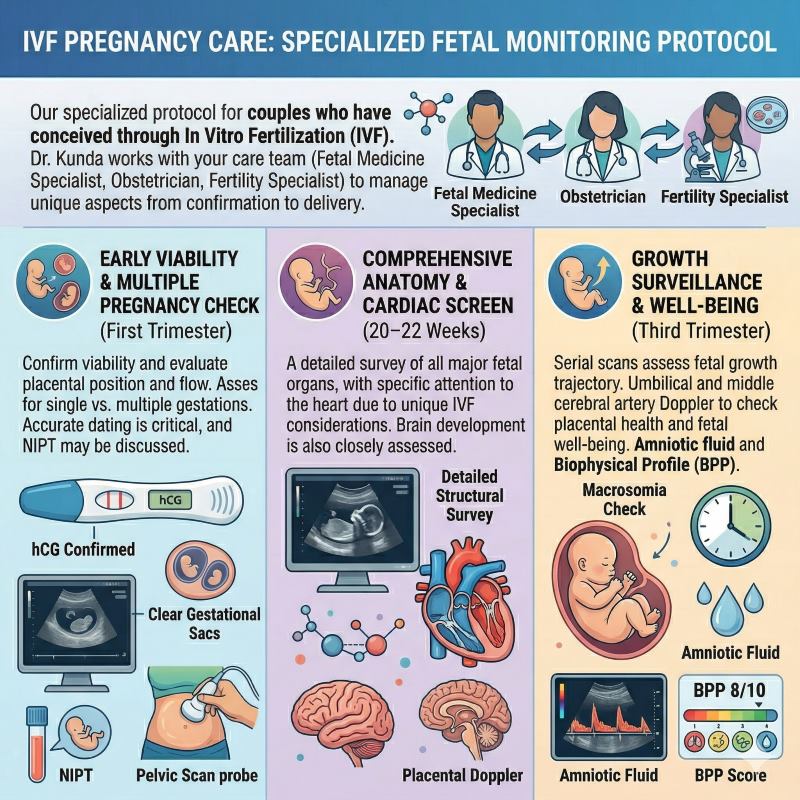
The IVF Monitoring Protocol
Your fertility specialist helped you achieve this miracle; our job is to ensure it arrives safely. Here is how we actively protect your baby week by week.
1. First Trimester: The NT & Pre-Eclampsia Scan
Between 11-14 weeks, we perform a rigorous Nuchal Translucency (NT) Scan. Crucially, we also run a Uterine Artery Doppler analysis. Because IVF mothers have a higher risk of Pre-Eclampsia, this Doppler allows us to detect the risk early and start preventative medication.
2. Second Trimester: TIFFA & Fetal Echo
At 18-20 weeks, we conduct the Targeted Anomaly Scan (TIFFA) to meticulously evaluate the baby's entire anatomy. Shortly after, between 20-24 weeks, Dr. Kunda performs the mandatory Fetal Echocardiogram to map the structural walls and valves of the baby's heart.
3. Third Trimester: Placental Surveillance
We switch our focus to the placenta. Serial Growth & Color Doppler Scans ensure the baby is receiving sufficient oxygen and nutrients. If the placenta begins to age prematurely (a known risk in IVF), we can intervene and safely plan your delivery.