
Diagnostic Clarity & Intervention
Safeguarding Your Baby's Environment.
A diagnosis of Oligohydramnios (low amniotic fluid) can trigger fear and premature deliveries. Dr. Kunda Shahane provides the elite Doppler surveillance and structural expertise needed to uncover the exact cause and safely prolong your pregnancy.
Schedule an Investigation ScanReplacing Panic with Precision.
Amniotic fluid is vital. It acts as a protective cushion for your baby, allows their lungs to expand and develop, and prevents the umbilical cord from being compressed against the uterine wall. When a routine scan shows your fluid is low, it is a highly stressful moment.
However, panic—or rushing to an immediate, very premature delivery—is rarely the best first step. Amniotic fluid is largely composed of fetal urine. If it is low, it means the baby is producing less urine, or fluid is escaping. To fix the problem, we must first find the "why." This requires operating far beyond a basic ultrasound.
The Hidden Causes We Investigate
Our targeted fetal anomaly scans are designed to rule out or diagnose the specific triggers of low amniotic fluid.
Placental Insufficiency
This is the most common cause in the third trimester. If the placenta begins to age prematurely or is affected by maternal high blood pressure, it delivers less oxygen to the baby. The baby compensates by shunting blood away from its kidneys and toward its brain, resulting in less urine and dropping fluid levels.
Fetal Renal (Kidney) Anomalies
Because amniotic fluid in the second half of pregnancy is primarily fetal urine, an issue with the baby's kidneys or a blockage in their urinary tract (like PUV) will immediately cause fluid levels to drop. Dr. Kunda performs microscopic structural scans to rule this out entirely.
Premature Rupture of Membranes (PROM)
Sometimes, a microscopic, slow leak in the amniotic sac can cause fluid levels to gradually decline without the mother experiencing a sudden "water breaking" event. We perform specific clinical tests to confirm if the amniotic sac is intact.
Fetal Growth Restriction (FGR)
Oligohydramnios and Fetal Growth Restriction frequently go hand-in-hand. If the baby is small due to a lack of nutrients, their fluid output drops. We meticulously track the baby's growth curves against their expected gestational age.
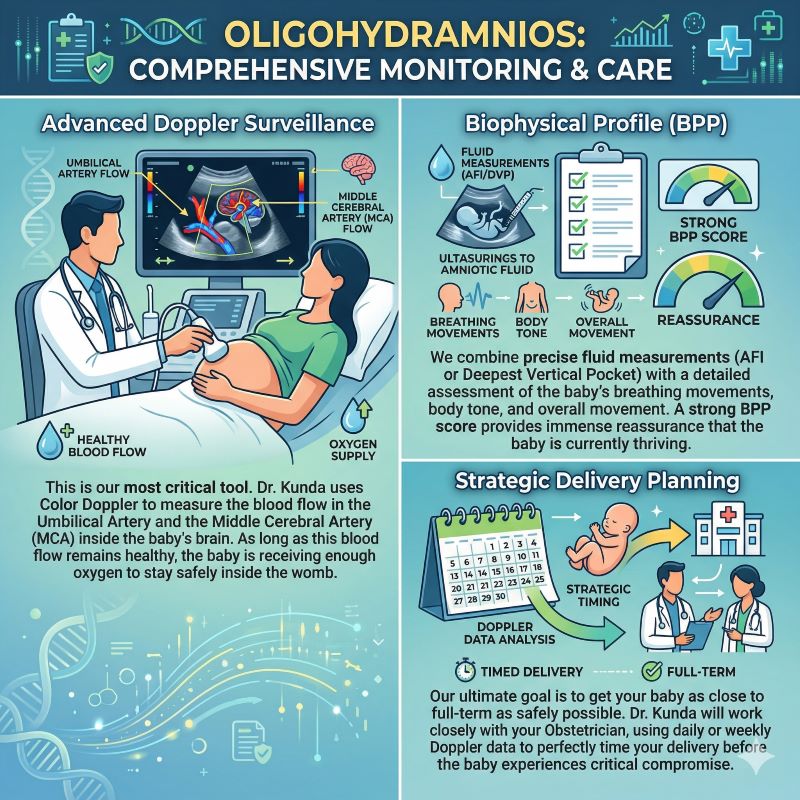
The Surveillance Protocol
Once Oligohydramnios is diagnosed, your pregnancy requires a highly vigilant, specialized monitoring plan to prevent umbilical cord compression and ensure fetal safety.
Advanced Doppler Surveillance
This is our most critical tool. Dr. Kunda uses Color Doppler to measure the blood flow in the Umbilical Artery and the Middle Cerebral Artery (MCA) inside the baby's brain. As long as this blood flow remains healthy, the baby is receiving enough oxygen to stay safely inside the womb.
Biophysical Profile (BPP)
We combine precise fluid measurements (AFI or Deepest Vertical Pocket) with a detailed assessment of the baby's breathing movements, body tone, and overall movement. A strong BPP score provides immense reassurance that the baby is currently thriving.
Strategic Delivery Planning
Our ultimate goal is to get your baby as close to full-term as safely possible. Dr. Kunda will work closely with your Obstetrician, using daily or weekly Doppler data to perfectly time your delivery before the baby experiences any distress.