
Precision, Safety, and Compassion
Diagnostic & Therapeutic Fetal Procedures
When complex questions arise, we provide the answers. Dr. Kunda Shahane specializes in advanced ultrasound-guided interventions, turning high-risk challenges into manageable medical solutions.
Expertise You Can Trust Completely
The thought of a needle near your baby is naturally terrifying. However, modern fetal interventions are highly advanced, minimally invasive procedures. Using continuous GE Voluson AI ultrasound guidance, Dr. Kunda performs these procedures with microscopic precision. Our priority is your absolute safety, comfort, and providing you with definitive genetic answers or life-saving therapies.
Diagnostic Procedures
Performed to find definitive answers regarding your baby's genetic health or to detect infections.
Amniocentesis
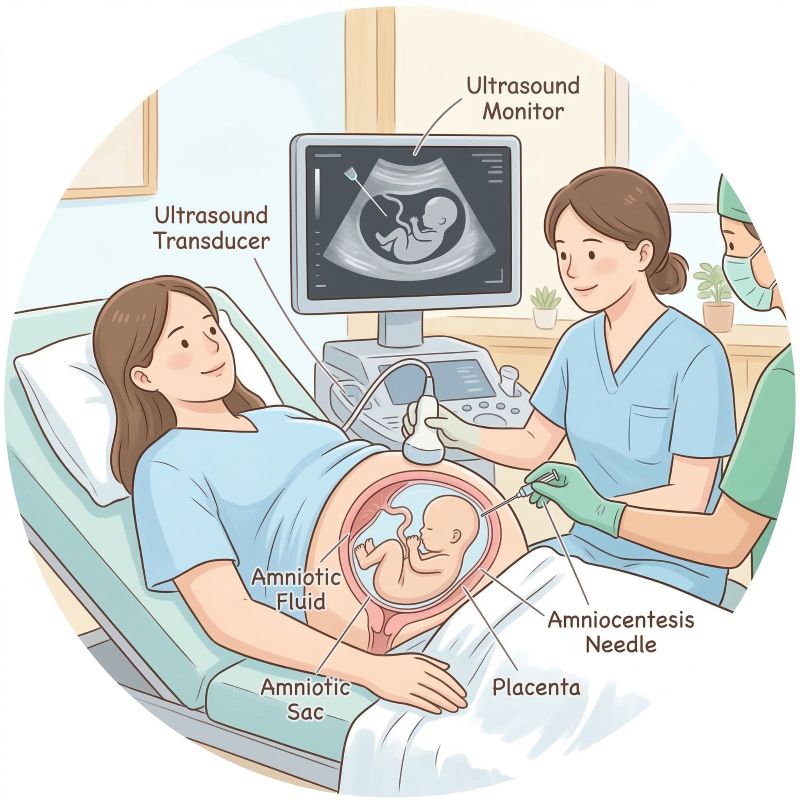
The gold standard for genetic testing. A very fine needle is used to extract a tiny amount of amniotic fluid (which contains the baby's cells) to test for Down syndrome, Thalassemia, and other chromosomal conditions.
- Performed after 15 weeks of pregnancy.
- Guided 100% by real-time ultrasound.
- Procedure takes less than 2 minutes.
- Miscarriage risk in expert hands is remarkably low (approx 0.1%).
Chorionic Villus Sampling (CVS)
Similar to Amniocentesis, but performed earlier in the pregnancy by taking a tiny biopsy of the placenta. This provides rapid genetic answers during the first trimester.
- Performed between 11 and 14 weeks.
- Crucial for parents with a known family history of genetic disorders.
- Allows for early decision-making and peace of mind.
Cordocentesis (FBS)
Also known as Fetal Blood Sampling. A highly specialized procedure where a blood sample is taken directly from the fetal umbilical cord.
- Used to quickly diagnose fetal anemia (due to Rh-incompatibility).
- Helps diagnose severe fetal infections (like Parvovirus or Toxoplasmosis).
- Can be converted immediately into a therapeutic blood transfusion if needed.
Therapeutic Interventions
Advanced in-utero surgeries and treatments performed by Dr. Kunda to actively heal or protect the baby before birth.
Intrauterine Fetal Blood Transfusion (IUT)
A life-saving procedure for babies suffering from severe anemia, usually caused by Rh-negative maternal blood attacking the baby's red blood cells. Donor blood is transfused directly into the baby's umbilical cord.
- Instantly treats fetal heart failure (hydrops).
- Allows the baby to safely reach maturity for delivery.
- Mayflower is one of the few clinics in Central India equipped for this.
Amnioreduction & Amnioinfusion
Therapies to physically balance the amniotic fluid levels around the baby to prevent premature labor or protect the umbilical cord.
- Amnioreduction: Draining excess fluid (Polyhydramnios) to relieve maternal pain and stop early labor.
- Amnioinfusion: Injecting sterile saline (Oligohydramnios) to create a cushion protecting the baby and cord.
Laser Ablation in TTTS
In Monochorionic twins (sharing a placenta), abnormal blood vessels can cause Twin-to-Twin Transfusion Syndrome, where one baby receives too much blood and the other too little.
- A highly advanced fetoscopic surgery.
- A laser is used to seal the abnormal connecting vessels in the placenta.
- Halt the progression of the disease and saves both twins.
Fetal Shunt Placement
If a baby develops a severe fluid blockage (such as fluid in the lungs or a blocked bladder), a tiny tube (shunt) is inserted through the mother's abdomen into the baby to drain the fluid into the amniotic sac.
- Vesico-Amniotic Shunts for lower urinary tract blockages.
- Pleuro-Amniotic Shunts for chest fluid accumulations.
What to Expect: Your Procedure Guide
We believe in total transparency. Knowing exactly how to prepare and what to do afterward significantly reduces anxiety and ensures the safest outcome.
Before You Arrive (Preparation)
- Diet: You do NOT need to be on an empty stomach. Eat a normal, light meal before coming in to prevent dizziness.
- Bladder: For early CVS, a moderately full bladder may be needed. For Amniocentesis, an empty bladder is preferred. We will guide you upon arrival.
- Medications: Inform us of any blood thinners (like Aspirin or Heparin) you are taking; we may ask you to pause them 24 hours prior.
- Support: Please bring your partner or a family member to drive you home safely.
During the Procedure
- Sterility: The area will be thoroughly cleaned with antiseptic to prevent infection. Sterile drapes will be applied.
- Ultrasound Guidance: Dr. Kunda uses continuous ultrasound to map a safe path for the needle, completely avoiding the baby.
- Pain: Most mothers describe the feeling as a standard blood test scratch or a mild menstrual-like cramp. Local anesthetic is used for certain therapies.
- Time: The actual needle insertion usually lasts less than 2 minutes.
Aftercare & Precautions
- Rest: Strict bed rest is not required, but you must rest at home for 24-48 hours. Avoid lifting heavy objects, exercise, and sexual intercourse for 3 days.
- Normal Symptoms: Mild cramping or a tiny drop of vaginal spotting is normal within the first 24 hours. You may take plain Paracetamol for cramps.
- When to Call Us: Contact the clinic immediately if you experience heavy bleeding, clear fluid leaking from the vagina, a fever, or severe, persistent abdominal pain.
Do You Have Questions About a Procedure?
Our team is here to provide clarity, comfort, and world-class care.
Contact Our Care TeamThe Operating Room Inside the Womb
In the past, doctors had to wait until a baby was born to treat life-threatening conditions. Today, Dr. Kunda Shahane utilizes advanced, minimally invasive techniques to treat your baby while they remain safely insulated inside your uterus.
No Large Incisions
When mothers hear "fetal surgery," they often picture a large abdominal operation. In reality, almost all fetal interventions (like blood transfusions, amniotic fluid drainage, or fluid shunts) are performed using an ultra-fine, microscopic needle. Dr. Kunda guides this needle with absolute, millimeter precision using continuous, high-definition ultrasound on the outside of your abdomen.
Absolute Pain Management
Your comfort and your baby’s safety are our highest priorities. The mother's skin is thoroughly numbed with local anesthesia. For more complex procedures where the baby must not move, safe medication is delivered directly to the baby via the umbilical cord to ensure they sleep peacefully and feel absolutely no pain during the intervention.